
ReviewExpo is reader-supported: some links on this page are affiliate links, and as an Amazon Associate ReviewExpo earns from qualifying purchases at no extra cost to you. Learn more.
Max capacity for a 360 camera booth is typically between 2 and 5 people depending on the intended use case. You should select a rig capable of holding at least 4 people if you plan to host a large group, or 2 people for standard social media content creation.
Recommended Max Capacity for 360 Camera Booths
| Use Case | Recommended Max Capacity | Why this number |
|---|---|---|
| Solo Content Creation | 1-2 people | Allows for a single creator and a secondary person or prop. |
| Small Group Social Media | 2-3 people | Accommodates a small group of friends or a couple. |
| Standard Event Booth | 4 people | Calculated for a group of 4 people to fit on the platform simultaneously. |
| Large Group/Corporate Event | 5+ people | Required for large groups where 4 people is the minimum threshold. |
| Professional Performance | 1-2 people | Focuses on a single performer with high-torque requirements for stability. |
360 Camera Booths we have reviewed in detail
From $599 to $2199: 3 of the 15 in this category we have reviewed in full.
If you need cinematic footage, see our comparison of the best 360 slow motion camera booth.
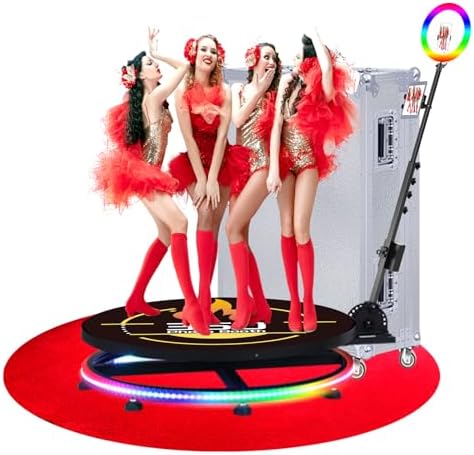


What Happens if You Underbuy or Overbuy Max Capacity
If you choose a 360 camera booth with a max capacity lower than your needs, the hardware may experience a motor stall. A motor stall occurs when the rotational force produced by the motor is insufficient to move the weight of the people on the platform, causing the rig to stop spinning entirely. This creates a physical bottleneck where groups must split up into multiple rotations, increasing the time a guest spends waiting in line.
Beginners should first learn about the different types of 360 camera booths.
Why overbuying 360 camera booth capacity wastes money and space
Overbuying capacity means investing in a platform that supports more people than your target audience will ever occupy. While a larger platform might seem safer, it increases the physical footprint of the rig, which can be a logistical hurdle in smaller venues. You lose money on a larger base and motor when a smaller, more efficient rig would have met your requirements without the extra cost. It is like buying a heavy-duty freight truck to move a single suitcase; you pay for weight capacity you will never use.
If these aren’t right for you, explore the alternatives to a 360 camera booth.
The Mistake of Optimising for People Instead of Space
Many buyers make the mistake of only looking at the number of people a 360 camera booth can hold without considering the physical platform diameter. While a rig might state a max capacity of 4 people, the actual usable area is limited by the circular base width. If the platform diameter is too narrow, 4 people will be crowded together, making it difficult for them to move or pose naturally during the spin.
Take a look at our full YCKJNB 360 Booth review for detailed specifications.
Choosing a 360 camera booth platform diameter for group comfort
You should instead optimise for the “comfort zone” of the group. For a group of 3, you want a platform diameter that allows each person enough space to move their arms and legs without colliding with the edge or each other. If the diameter is too small for the stated capacity, the result is a cramped experience that looks poor on camera. Prioritise a platform diameter that provides a comfortable buffer for your specific group size rather than just hitting a person count.
Review the hardware specs in our full MWE 360 Booth review.
How Max Capacity Interacts with Other Deciding Specs
Max capacity interacts directly with motor torque, which measures the rotational force produced by the motor. A high max capacity figure is wasted if the motor torque is not sufficient to move that specific weight. If you select a booth for 5 people, the motor must be rated to handle the combined weight of those individuals plus the weight of the platform itself. Without sufficient torque, the rig will fail to maintain a consistent rotation speed, leading to a jerky video.
Check out our full LIKVIDIU 360 Booth review to see its travel features.
How 360 camera booth stability depends on base width and torque
Max capacity also impacts the platform diameter and the stability of the rig. A larger capacity usually requires a wider base to distribute weight evenly. If you choose a high capacity but the base is too narrow, the center of gravity becomes unstable. This can lead to a failure mode where the rig wobbles or tips during high-speed rotations. You must ensure the motor torque and the platform diameter are scaled to support the max capacity you require for your specific use case.
Evaluate the technical specs in our full ZANOGI MWE360-C-CD review.
Balancing 360 camera booth capacity with hourly guest throughput
Finally, consider how max capacity affects the time someone spends on the platform. A larger group takes longer to pose and position themselves. If your goal is high-volume throughput, a lower max capacity with a faster rotation speed might be more efficient than a high-capacity rig that takes a long time to set up for each group. Balancing the number of people with the speed of the spin determines how many people you can serve per hour.
More spinning camera rig explainers and comparisons
- Which 360 Photo Booth with App Remote Control Is Best?
- Best 360 Photo Booths for Small Spaces Under $600
- Slow Motion 360 Camera Booths Compared
- Choosing the Best 360 Photo Booth for Professional Events Under $1500
- The 360 Photo Booths That Work Best with Ring Lights
- Which 360 Camera Booth Works Best for Corporate Events?