
ReviewExpo is reader-supported: some links on this page are affiliate links, and as an Amazon Associate ReviewExpo earns from qualifying purchases at no extra cost to you. Learn more.
Mount Type for cinema lenses is the physical interface that connects the lens to a camera body, determined by the specific camera system you own. You must match the lens mount to your camera’s native mount to ensure the lens can be physically attached and electronically communicated with.
Which Cinema Lens Mount Suits Your Setup?
| If this is you | The Mount Type that suits you | Why |
|---|---|---|
| You own a professional cinema camera like an Arri or RED | PL Mount | This is the industry standard for professional film production and allows for high-torque gear and heavy glass. |
| You use a mirrorless camera for high-end video | E, RF, or Sony FE Mounts | These are native mounts for modern mirrorless systems that provide compact designs and full autofocus data. |
| You are using a legacy DSLR or older mirrorless body | EF or E-mount | These mounts provide a wide range of existing glass and are common in hybrid photography and video workflows. |
| You are building a specialized indie production rig | L-Mount | This is a common standard for compact cinema bodies and allows for a versatile ecosystem of cinema-specific glass. |
Products in this category with a full review here
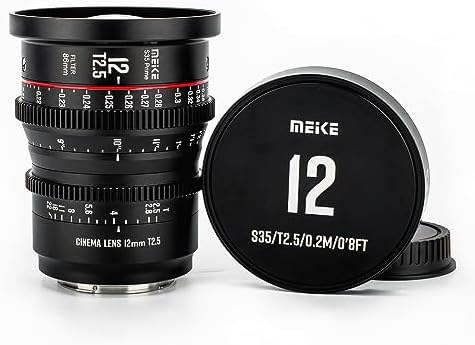
3 options shown here, $369 to $799.99, each with its own full review behind its name.


How to Measure and Establish Your Cinema Lens Mount Type
Identifying your required mount type depends on the specific camera body you intend to use, as the mount is a physical hardware limitation. To establish your value, look at the physical connection point on your camera body or check the manufacturer’s technical specifications for the “Mount” or “Lens Mount” entry. Most modern cameras will list this as a letter or a combination of letters, such as “E-Mount” or “PL Mount”.
Identifying camera mount designations and the role of mechanical adapters
If you are unsure what your camera uses, check the bottom of the camera body or the side of the lens mount ring for a stamped designation. For example, a camera that accepts “Sony E” means you need a lens with an “E-Mount” designation. If you are planning to use a camera and a lens that have different native mounts, you must determine if a mechanical adapter is required. An adapter is a piece of hardware that allows a lens from one mount system, such as EF, to be physically attached to a different system, such as Sony E-mount.
Verifying cinema lens mount specifications before purchasing glass
When you are looking at a cinema lens listing, the mount type is usually listed in the primary specifications. If the listing states “N/A” or does not specify a mount, the glass may be a “lensless” system or a specialized cinema glass that requires a specific adapter not listed in the primary data. You should verify the exact mount name, such as “PL” or “L”, before completing a purchase to ensure the lens will physically seat on your camera’s mounting flange.
What Goes Wrong with the Wrong Cinema Lens Mount?
The primary risk of selecting the incorrect mount type is a physical mismatch where the lens cannot be attached to the camera body. If you order a PL mount lens for a mirrorless camera without an adapter, the lens will be physically incompatible because the diameter of the mount flange and the spacing of the mounting holes will not align. This results in a complete inability to use the glass on your current hardware.
How incorrect flange focal distances cause blurry images and focus failure
In cases where a lens and camera have different mounts but you attempt to use a poorly fitted or incorrect adapter, you risk mechanical damage. An incorrect adapter might not provide the correct “flange focal distance,” which is the distance from the mount to the sensor. If this distance is off by even a fraction of a millimeter, the lens will not be able to focus on the subject at any distance. This error shows up in use as a “soft” image where even the closest objects are blurry, or as a total inability to achieve focus.
If you are shooting on a Sony system, see our list of best anamorphic lens for e mount options.
Loss of metadata and physical port access when using manual mounts
Furthermore, using a mount that does not support electronic communication can lead to a loss of metadata. For instance, if you use a manual mount on a camera that expects electronic signals, the camera may not be able to display the correct focal length or aperture on the screen. This requires the operator to manually verify every setting, increasing the risk of errors during a high-pressure film production. If the mount is too large for the camera body, it may also physically block access to other ports or the screen, hindering the practical operation of the rig.
What to Do When You Fall Between Two Mount Types?
When a buyer falls between two mount types, it usually means they are considering a camera system that can accept multiple mounts or they are deciding between two different camera brands. If you are choosing between two different camera systems, you must decide which ecosystem offers the best glass selection for your specific needs. If you choose a system like PL, you are committing to a professional standard that often requires larger camera bodies and specialized accessories.
Prioritising camera mounts with the widest variety of available cinema glass
If you are in a situation where your camera can accept multiple mounts through different adapters, you should choose the mount that offers the widest variety of glass in your price range. For example, if you can use both EF and L-mounts via adapters, you should look at the number of available cinema lenses for each. If one system has a significantly larger selection of cinema-grade glass, that is the mount you should prioritize for your lens purchases. This ensures that as your production needs grow, you have a wider variety of focal lengths and apertures to choose from.
Choosing a mount based on required focal length versatility and camera features
Consider a scenario where you are filming a fast-paced sports event and need to switch between a wide-angle and a telephoto lens quickly. If your current camera mount has a limited selection of cinema glass, you might find yourself struggling to find the right focal length. In this case, it is better to choose the mount that supports the most versatile range of glass. If you are currently using a mirrorless system but are considering a transition to a professional cinema camera, you must decide if the cost of a new lens set for a PL mount is justified by the professional features of that camera. If the answer is yes, then the PL mount is your target, regardless of your current mirrorless setup.
How Adapters Affect Cinema Lens Mount Choice
Adapters can bridge the gap between different mount types, but they are not a universal solution for every cinema lens. Some high-end cinema lenses have a “lens barrel” that is so large it will not fit onto a standard adapter for a small mirrorless camera. You must check the physical dimensions of the lens barrel to ensure it can clear the adapter and the camera body. If the barrel is too wide, you cannot use that lens on your camera, regardless of whether an adapter exists for the mount type.
Deciding between native mounts and adapters for frequent lens swapping
When choosing between two systems, ask yourself: will I need to swap lenses frequently during a shoot? If you need to swap lenses every few minutes, a native mount is often more reliable than an adapter, as adapters can sometimes introduce slight shifts in the optical axis. If you are only using one lens for the entire production, an adapter is a perfectly acceptable way to use a different mount type. This distinction helps you decide if you need to buy a new camera body to match your lenses or if an adapter is sufficient for your workflow.
The rest of our cinema lens guides
- Which Cinema Lens Captures Wide Angle Shots for Small Spaces?
- The Cinema Lenses That Give a Vintage Film Aesthetic on a Digital Camera
- The Anamorphic Lenses That Work Best for APS-C Cameras
- Which Cinema Lens Is Best for the BMPCC 4K?
- Best Anamorphic Lenses for E Mount Systems
- Prime Cinema Lenses for M43 Mount Compared