
ReviewExpo is reader-supported: some links on this page are affiliate links, and as an Amazon Associate ReviewExpo earns from qualifying purchases at no extra cost to you. Learn more.
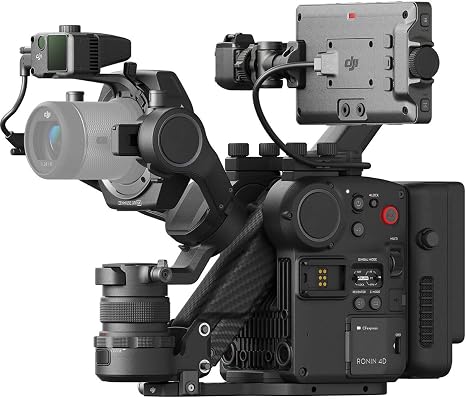
DJI Ronin 4D-6K
The Ronin 4D-6K stabilizes footage on a 4-axis gimbal, so it suits you if you need smooth cinematic motion.
120 fps frame rate
- Frame Rate
- 120 fps – at or above the 120fps at 4K resolution reference figure
3.5/5 from 6 buyers
- Average buyer rating
- 3.5 out of 5
- Ratings behind it
- 6
- What that supports
- Too small a sample to conclude anything either way
- Where it comes from
- The product listing, read 7 November 2026
3 deciding specs not stated
- Resolution
- Not stated in the listing – confirm with the seller before ordering
- Bit Depth
- Not stated in the listing – confirm with the seller before ordering
- Sensor Size
- Not stated in the listing – confirm with the seller before ordering
Suits independent documentary filmmakers
- Independent documentary filmmakers
- Commercial production houses
- Music video directors
- Live event videographers
What the Ronin 4D-6K Is, and Who For
DJI Ronin 4D-6K records at 120 fps, which is sufficient for those who need to capture high-quality 4K slow motion.
A filmmaking camera with 14 plus stops of dynamic range allows for high-contrast scenes to retain detail in both highlights and shadows. The DJI Ronin 4D-6K provides this range, giving you more flexibility during the color grading process of a production.
The Ronin 4D-6K also includes internal recording for Apple ProRes RAW and ProRes 422 HQ. These formats allow you to capture high-quality data directly to the camera’s internal storage.
We evaluated 17 cinema cameras and selected this model for a full review because it had the 7th most buyer ratings among the screened options. This review is for users who require high-fidelity internal recording and wide dynamic range.
How Review Expo picked: we started from the 200 most-reviewed cinema camera listings in our retail dataset, removed duplicates, accessories and off-category products, and 17 qualified. This product is one of 6 from that pool chosen for a full review. Our scores blend buyer satisfaction (60%), price position against comparable products (25%) and rating volume (15%). Specifications come from manufacturer listings and ratings from verified Amazon buyer reviews (data checked November 2026).
The Short Answer on the Ronin 4D-6K
Best for: you need an all-in-one filmmaking camera that integrates a 4-axis gimbal and LiDAR focusing for complex, low-light tracking shots.
The DJI Ronin 4D-6K is a professional choice at the $6699 mark.
- Pro: The 120 fps frame rate allows for high-quality slow motion at 4K resolution.
- Pro: Integrated LiDAR focusing enables the camera to maintain focus in low-lit environments or on manual lenses.
- Pro: Built-in 9-stop ND filters allow for exposure control in various lighting conditions without extra glass.
- Con: The 10.27-pound weight makes it heavy for long handheld carries without a support rig.
- Con: A 3.5 rating from 6 buyer ratings provides insufficient data to confirm long-term reliability.
Don’t buy this if: you require a lightweight handheld setup, as the 10.27-pound weight exceeds the limits of standard handheld operation.
Price assessment: The $6699 price is premium for a system that combines a 6K camera with a 4-axis gimbal and LiDAR tech.
Review Expo score: 5.1/10 (data-driven – see “How we picked” above)
The Numbers on the Spec Sheet
| Frame Rate | 120 fps |
| Bit Depth | Not stated |
| Weight | 10.27 pounds |
| Recording Format | ProRes |
| Internal Storage | Yes |
| Gimbal Integration | Yes |
| Dynamic Range | 14 plus stops |
| ND Filters | Built-in 9-stop |
Frame Rate measures the number of individual images captured every second, and the Ronin 4D-6K provides 120 fps.
Before You Buy: Cinema Camera Checklist
The first thing to check is whether your current lens collection is compatible with the camera’s mounting system.
- ☐ Confirm the mount type—the Ronin 4D-6K uses interchangeable lens mounts—to ensure you do not have to purchase a new lens set.
- ☐ Verify the 120 fps frame rate—the threshold for high-quality slow motion without significant resolution loss—to ensure it meets your specific footage needs.
- ☐ Check for internal storage—the Ronin 4D-6K states it has internal recording—to avoid needing an external drive for every shot.
- ☐ Budget for the 10.27 pounds weight—the weight of the unit—to ensure your current gimbal or support system can carry the load without failing.
- ☐ Confirm the recording format—it supports ProRes and Apple ProRes RAW—to ensure your current editing workflow can handle the specific file types.
- ☐ Verify the 14 plus stops of dynamic range—the range of light and shadow detail—to ensure the camera captures enough detail in high-contrast environments.
You should not buy this camera if your current support rig cannot accommodate a 10.27-pound weight or if your workflow cannot support the ProRes data rates.
Practical Performance of This Cinema Camera
How LiDAR Technology Enables Focusing in Low-Lit Environments
LiDAR focusing allows you to achieve focus in extremely low-light environments where traditional contrast detection fails because it uses light pulses rather than visible light. The Ronin 4D-6K includes LiDAR autofocus for low-lit environments and manual lenses, which provides a consistent point of reference for the focus motor when the scene lacks distinct visual textures. This technology ensures that the camera can maintain a sharp subject even in near-darkness where standard sensors would struggle to find a focal point.
The Ronin 4D-6K also includes LiDAR Waveform, a visual tool that helps you see the focus distance and depth of field in your viewfinder. Because the system provides a 14 plus stops of dynamic range and dual native ISO, you can maintain image integrity while the LiDAR system manages the technical task of finding the correct plane. This combination allows for more reliable operation in high-contrast or low-light cinema environments where manual pulling of focus is difficult to judge by eye alone.
O3 Pro Technology Provides 1080p/60fps Wireless Video Transmission
O3 Pro Video Transmission Technology provides 1080p/60fps video transmission to your remote monitoring setup. This specific transmission rate allows you to monitor the live feed on a remote screen with smooth motion, which is useful for coordinating large film crews or checking framing from a distance. The system operates across DFS frequency bands, which helps maintain a stable signal in environments where common wireless frequencies might be crowded or interfered with.
The Ronin 4D-6K supports remote control of the gimbal, focusing, and camera settings through this wireless link. Because the transmission is limited to 1080p/60fps, you can expect a clear enough image for production monitoring, though you should not rely on it for high-resolution playback. This setup enables a single operator to manage the camera’s physical orientation and focus points from a distance, which simplifies the workflow for complex shots that require remote adjustments.
4-Axis Gimbal and Z-Axis Stabilization Keep Footage Steady
The Ronin 4D-6K features a 4-axis gimbal and Z-Axis stabilization to keep your footage steady during movement. This configuration allows you to record a 10-minute 4K slow motion clip or a 30-minute 4K video while maintaining smooth motion, as the 120 fps capability provides the necessary frame count for high-quality slow motion. The integrated design means the stabilization hardware and the X9-8K or X9-6K gimbal cameras work as a single unit to minimize the risk of jerky movements during operation.
You can record 120 fps while using the Apple ProRes RAW or ProRes 422 HQ internal recording formats. These high-bitrate codecs are supported by the internal storage, allowing the camera to capture high-frame-rate data without the bitrate bottlenecks that often occur when recording high-quality cinema files. Because the 120 fps capability meets the threshold for high-quality slow motion without significant resolution loss, you can capture fluid, high-speed action while retaining the professional color depth required for final grading.
Common Buyer Jobs Checked Against the Ronin 4D-6K’s Specs
The Ronin 4D-6K against the jobs buyers ask about, worked out from its listed frame rate and a typical need for each job.
| Job | What it takes | Ronin 4D-6K |
|---|---|---|
| Record a 10-minute 4K slow motion clip | at least 120 fps | Yes – 120 fps |
| Record a 10-minute 4K 60fps video | at least 60 fps | Yes – 120 fps |
| Record a 30-minute 4K video | at least 24 to 60 fps | Yes – 120 fps |
Understanding your budget is essential, so explore what cinema cameras cost at every price level.
Where the Ronin 4D-6K Sits Among the Alternatives
The DJI Ronin 4D-6K provides a high frame rate of 120 fps, which is the threshold for high-quality slow motion without significant resolution loss.
- The Sony FX3 Full-Frame Cinema Camera matches the Ronin 4D-6K at 120 fps.
- The Sony FX6 Digital Cinema Camera Kit also matches the Ronin 4D-6K at 120 fps.
- The Sony FX3 Full-Frame Cinema Camera is $3 cheaper than the Ronin 4D-6K.
- The Sony FX3A Full-Frame Cinema Camera is $801 cheaper than the Ronin 4D-6K.
- The Panasonic AU-EVA1 5.7K Super 35 Handheld Cinema Camera is $1,484.05 cheaper than the Ronin 4D-6K.
- The Amazon Renewed Canon EOS C400 6K Full-Frame Cinema is $1,699.05 cheaper than the Ronin 4D-6K.
If you need a more compact filmmaking camera for a lower price point, the Sony FX3A Full-Frame Cinema Camera is the better pick.
What the deciding spec costs here: Measured as price per unit of Frame Rate, the reviewed product works out to $55.83 against a $30.86 median across the 10 other screened products that state the spec, and 7 of them deliver more of it per dollar. The cheapest screened product that beats its 120 fps is the E2-M4 at $1499 with 160fps, which is $5200 less than this one for more of the spec that decides this category.
If you are considering a more compact body, explore our full review of the Z CAM E2C.
Professionals seeking a compact full-frame option can view our spec breakdown of the Sony FX3.
What the Price Buys
At this price point, you get a 4-axis gimbal with integrated LiDAR focusing—a system that uses light pulses to map depth for sharper focus in low-lit environments—and O3 Pro Video Transmission Technology for 1080p/60fps wireless feeds. You move from a standard handheld setup to a stabilized filmmaking camera that handles Z-Axis stabilization and ActiveTrack Pro tracking. You choose the Ronin 4D-6K when your workflow requires a 120 fps frame rate for high-quality slow motion and you need the specific 14 plus stops of dynamic range provided by the X9-8K and X9-6K gimbal cameras.
Where this sits in the buyer data: Among the 11 products screened for this category, this one’s 3.5 rating places it #10, on 6 ratings – below the 10-rating median of that group, so treat the average as less settled than its comparables. On price it undercuts 2 of them.
What It Takes to Run the Ronin 4D-6K
Setting Up the Ronin 4D-6K
You need a V-Mount Battery to provide extended power for long production days before you can begin filming.
- Unpack the Ronin 4D-6K and mount the X9-8K or X9-6K gimbal cameras to the integrated frame.
- Attach the V-Mount Battery to the power port to ensure the 4-axis gimbal has a consistent power source.
- Connect a Field Monitor to the wireless video transmission system to check focus and exposure on your screen.
- Insert a Media Card into the internal recording slot to begin capturing Apple ProRes RAW or H.264 footage.
Warranty and Support: What to Check
Warranty terms and support availability vary by seller and country.
- Confirm the internal storage functionality works to ensure the 14 plus stops of dynamic range are captured correctly.
- Verify the LiDAR focusing and ActiveTrack Pro features respond to movement to ensure the gimbal’s tracking is accurate.
- Check that the O3 Pro Video Transmission Technology maintains a stable 1080p/60fps signal at your intended range.
- Test the built-in 9-stop ND filters to ensure they move smoothly and adjust the light correctly.
Record a test clip and check for gimbal stability the day it arrives while your return window is still open.
Questions Buyers Ask About This Filmmaking Camera
Does the Ronin 4D-6K have enough ND filters for bright daylight?
Yes, the Ronin 4D-6K includes built-in 9-stop ND filters, which allow you to control light intake without adding external glass to the gimbal. This integrated system enables you to maintain a consistent shutter speed in high-brightness environments while keeping the camera’s balance stable.
What is the frame rate of the Ronin 4D-6K?
The Ronin 4D-6K captures video at 120 fps, which is the threshold for high-quality slow motion without significant resolution loss. This capability allows you to record a 10-minute 4K slow motion clip or a standard 60fps video with enough overhead for smooth motion.
Does the Ronin 4D-6K have internal storage?
Yes, the Ronin 4D-6K features internal recording for Apple ProRes RAW, ProRes 422 HQ, and H.264 formats. Having internal storage means you can record high-bitrate files directly to the camera body without worrying about external media write speeds.
What is the weight of the Ronin 4D-6K?
The Ronin 4D-6K weighs 10.27 pounds, which is a common weight for a cinema camera with integrated gimbal stabilization. You should consider how this weight affects your mobility, as it is one of the heavier options in the filmmaking camera category we evaluated.
Is the Ronin 4D-6K Right for You?
Who the Ronin 4D-6K suits and the jobs it is the wrong choice for, listed below with the reason for each.
Who this cinema camera is for, and what it does well
Who the Ronin 4D-6K suits
- Independent documentary filmmakers — the integrated 4-axis gimbal and camera design allows for high-quality handheld shots without a separate gimbal setup
- Commercial production houses — the Apple ProRes RAW and 14+ stops of dynamic range provide the high-end data needed for professional color grading
- Music video directors — the 120 fps frame rate allows for smooth slow-motion sequences during high-energy performances
- Live event videographers — the O3 Pro Video Transmission Technology and remote control of gimbal/focusing allow for seamless remote operation in large venues
- High-end real estate videographers — the LiDAR focusing and LiDAR Waveform allow for precise focus pulling even in low-lit interior environments
What this filmmaking camera handles well
- Slow-motion cinematography — 120 fps frame rate
- Low-light interior filming — LiDAR focusing for low-lit environments
- Remote camera operation — Remote control of gimbal, focusing, and camera settings
- Dynamic range heavy grading — 14 plus stops of dynamic range
- High-speed data logging — Internal recording of Apple ProRes RAW
- Stabilized tracking shots — ActiveTrack Pro and Z-Axis stabilization
What this filmmaking camera is the wrong choice for
- Ultra-high-speed sports capture — 120 fps limit restricts extremely high-speed slow motion
- Standard 4K/120fps workflows — The 6K sensor and 120fps spec may limit high-resolution slow motion compared to higher-tier cinema cameras
- Low-bandwidth remote monitoring — 1080p/60fps video transmission limits the resolution of the remote feed
What to budget alongside this cinema camera, and what to skip
Accessories worth buying with the Ronin 4D-6K
- External storage media — Required for internal recording of high-bitrate Apple ProRes RAW
- Additional batteries — Required to power the X9-8K/X9-6K gimbal cameras and internal recording
- Lens filters — Necessary to complement the built-in 9-stop ND filters for specific lighting conditions
- Rigging accessories — Needed to support the 10.27 pounds weight and large 12.17 x 11.42 x 10.91 inch dimensions
- Lens selection — Required to utilize the interchangeable lens mounts
Accessories you can skip buying for this cinema camera
- External ND filters — Built-in 9-stop ND filters are already included
- External gimbal — The 4-axis gimbal is integrated into the design
- Separate focusing motor — LiDAR focusing and remote control of focusing are built-in
To find the right fit for your production scale, see the best cinema camera for independent filmmakers.
Where to Buy This Cinema Camera
In November 2026 the Ronin 4D-6K was listed at $6699. Prices move, so read that as a snapshot, not a quote.
Cinema cameras are sold by the retailers below – we do not track which of them has the Ronin 4D-6K in stock, so check availability and the current price with the retailer before making a trip.
- Adorama (online and physical stores) — extensive inventory and professional camera support
- Amazon (online only) — broad availability and fast shipping
- B&H Photo Video (online and physical stores) — wide selection of professional cinema gear and trade accounts
- Fujiya Camera (online only) — specialist for used and refurbished cinema equipment
- Cine_Video_Store (online only) — specialist retailer for cinema cameras and accessories
- B&H Photo Video (online and physical stores) — wide selection of professional cinema gear and trade accounts
Final Verdict on the Ronin 4D-6K
If you are filming a high-speed action sequence, the Ronin 4D-6K provides the necessary 120 fps to capture smooth slow motion at 4K resolution. This frame rate allows for a 10-minute 4K slow motion clip without the resolution loss common in lower-tier filmmaking cameras.
The Ronin 4D-6K features LiDAR focusing, which uses light pulses to measure distance and lock onto subjects in low-lit environments. It also includes LiDAR Waveform to show focus distance for manual lenses. These systems allow for precise focus tracking even when traditional contrast-based systems fail. The device supports Apple ProRes RAW and H.264 recording formats, providing a choice between high-bitrate flexibility and standard compression.
This cinema camera includes a 4-axis gimbal for stabilization and O3 Pro Video Transmission Technology, which provides a 1080p/60fps wireless feed. With 14 plus stops of dynamic range, the camera captures detail in both bright highlights and deep shadows. The integrated design includes a built-in 9-stop ND filter, which reduces light entering the lens to maintain exposure in bright conditions.
You should choose the Ronin 4D-6K if you require a cinema camera that combines a stabilized gimbal with integrated LiDAR focusing and high-speed 120 fps recording. It is available for around $6,699.
The Ronin 4D-6K stands out for its ability to record at 120 fps, meeting the threshold for high-quality slow motion without significant resolution loss.
Skip it if: You need a lightweight setup, as the unit weighs 10.27 pounds, or if you require a more common gimbal configuration, as only 2 of the 17 screened listings state they include gimbal integration.
Every filmmaking camera guide in this category
- Best Cinema Cameras for 4K Video
- Cinema Cameras for 6K Video Under $3000 Compared
- Choosing the Best Cinema Camera for Handheld Shooting
- Capturing Cinematic Footage for YouTube Content With a Cinema Camera
- Which Cinema Camera Works Best for Professional Wedding Videography?
- The Cinema Cameras That Provide High Dynamic Range Video for Commercial Ads Under $8500