
ReviewExpo is reader-supported: some links on this page are affiliate links, and as an Amazon Associate ReviewExpo earns from qualifying purchases at no extra cost to you. Learn more.
Field of view for vr cameras should be at least 360 Degrees for immersive capture. You need a 360 Degree range to ensure no blind spots exist in the recorded environment, which requires you to measure the physical boundaries of your intended filming area before selecting a device.
Recommended Field of View Values for Vr Cameras
| Use Case | Recommended Field of View | Why this number |
|---|---|---|
| Full room capture | 360 Degrees | Capturing a full 360 degree view of a room requires a complete spherical range. |
| Wide-angle 360 view | 360 Degrees | A wide-angle 360 view requires at least 360 Degrees to maintain continuity. |
| Small space 360 video | 360 Degrees | Recording a 360 video for a small space requires at least 360 Degrees to avoid seams. |
| Head-mounted immersive view | >200 Degrees | Immersive head-mounted views require a wide horizontal span to minimize head movement. |
Products in this category with a full review here
Prices across these 3 run from $119.98 to $598.98; each one has a full review here.
Newcomers should start by reading our guide on how a vr camera works.


What happens if you go under or overbuy Field of View?
Going under the required Field of View for a vr camera results in stitching artifacts or “dead zones” where the camera cannot see. If you choose a device with a 180 Degree horizontal span for a 360 Degree project, the software cannot fill the missing data. This creates a broken experience for the viewer. The result is a video that feels like a standard wide-angle shot rather than an immersive environment.
Avoiding unnecessary costs from overbuying wide angle field of view
Overbuying Field of View involves selecting a sensor capable of extreme wide angles that your specific use case does not require. While 360 Degrees is the standard for spherical content, some hardware may offer slightly wider spherical coverage that provides no functional benefit for standard 360 video. This extra capability often leads to higher costs without increasing the quality of the final output. You pay for hardware you do not use.
If these options aren’t right, explore alternatives to traditional vr cameras.
What is the most common mistake buyers make with Field of View?
The most common mistake buyers make with Field of View is equating a high degree count with image clarity. A vr camera might state a 360 Degree Field of View, but this only measures the extent of the observable world visible at one time. It does not decide the pixel count or the resolution of the image. You might find a camera with a massive Field of View that produces a grainy, low-resolution result.
You can also learn about the different types of vr cameras available today.
Prioritising pixel density over angular span for sharp 360 views
You should optimize for resolution and pixel density instead of just the angular span. If the total count of individual color points is too low, the 360 Degree view will appear blurry or pixelated when viewed in a headset. High resolution ensures that the wide area remains sharp. Focus on the pixels per degree rather than just the degrees themselves.
How does Field of View interact with other vr camera specs?
Field of View interacts with storage capacity and processing speed because higher angular coverage requires more data to maintain quality. A 360 Degree Field of View must capture and encode every point in that sphere simultaneously. This puts a heavy load on the internal memory and the encoder. If the processing speed is insufficient, the camera may experience thermal throttling or frame drops during 8K or 5.7K encoding.
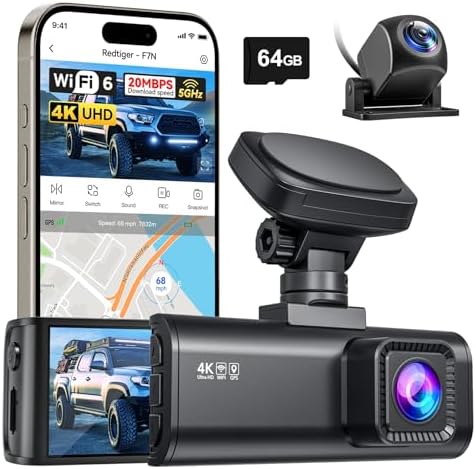
For a detailed breakdown, see our full REDTIGER F7N spec review.
How H.264 and H.265 standards manage wide field of view bitrates
Field of View also relies on the H.265 (HEVC) or H.264 standards to manage the bitrate. These standards dictate the bitrate efficiency required to maintain high-resolution 360-degree textures. Without efficient encoding, a wide Field of View results in a file size that is too large to store or stream effectively. You must balance the wide angle with the device’s ability to compress that data without losing detail.
You can view our analysis of how the Vantrue N2 Pro performs.
Why field of view does not affect motion smoothness or frame rate
Will a wider Field of View improve the smoothness of the motion? No, because frame rate measures the number of individual images displayed every second, not the area covered by each image. A camera can have a 360 Degree Field of View but still suffer from rolling shutter distortion if the frame rate is too low for fast movement. Smoothness is a function of how many frames the camera captures per second. Wide coverage is a function of how much of the room it sees at once.
How lens type and stitching software affect effective field of view
The physical sensor size and lens type also limit the effective Field of View. Even if a manufacturer claims a specific degree count, the lens must be capable of projecting that image onto the sensor without significant distortion. Poor software alignment can create visible seams or “ghosting” in the middle of the immersive view regardless of the degree count. This is a failure of stitching, not a failure of the Field of View measurement.
For a deep dive, see our full Meeting 360 Ultra breakdown.
Balancing breadth and detail for high quality immersive VR content
When choosing a vr camera, you must decide if your priority is the breadth of the scene or the depth of the detail. A 360 Degree Field of View provides the breadth. High resolution and high frame rates provide the depth. If you are capturing a wide-angle 360 view, you need both to work in tandem. A wide view with low resolution is unusable in a VR headset. A high-resolution view with a narrow Field of View is just a standard video. Balance is the requirement for immersive content.